
To be truly free, you must navigate the structure of freedom.
In my recent article, Freedom is the highest good, we found out that:
- Freedom is more important than comfort, inoffensiveness, equity, safety or indeed anything else.
- Maximising individual freedom is in general the best way to maximise everyone’s freedom.
- Minarchism (tiny government) is the best – because freedom-maximising – form of government.
- We need full freedom so we can build meaning in life by choosing to swap freedom for responsibility.
If you don’t immediately say “Hell yeah!” to these, do your future self a favour and read that article.
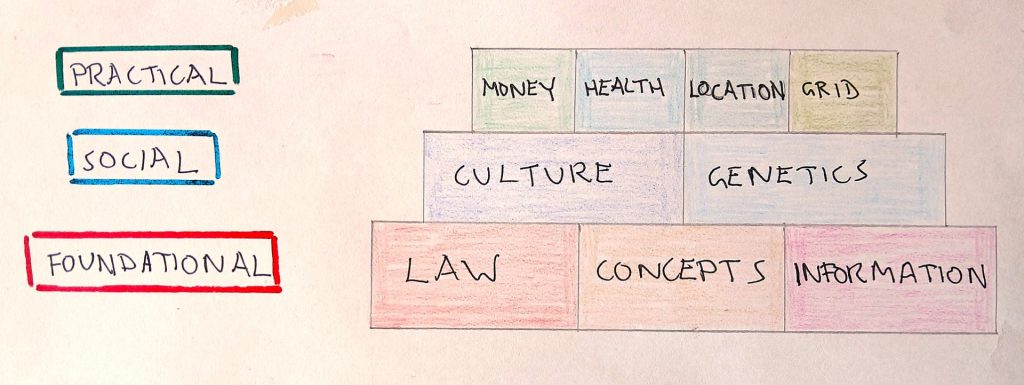
In this article, we will discover that different levels of freedom are not merely useful thinking tools, but real things that stack in a clear order. In other words, if you don’t secure freedom at the fundamental levels, your freedom at the higher levels is vulnerable.
Turning the steering wheel of your car means nothing if you’ve just driven off a cliff.
Some circumstances override others to such an extent that they make them irrelevant. This article is your map to which domains override which. My hope is that it saves you from driving off any metaphorical cliffs.

Shut up and show me all the freedoms already
Sure thing.
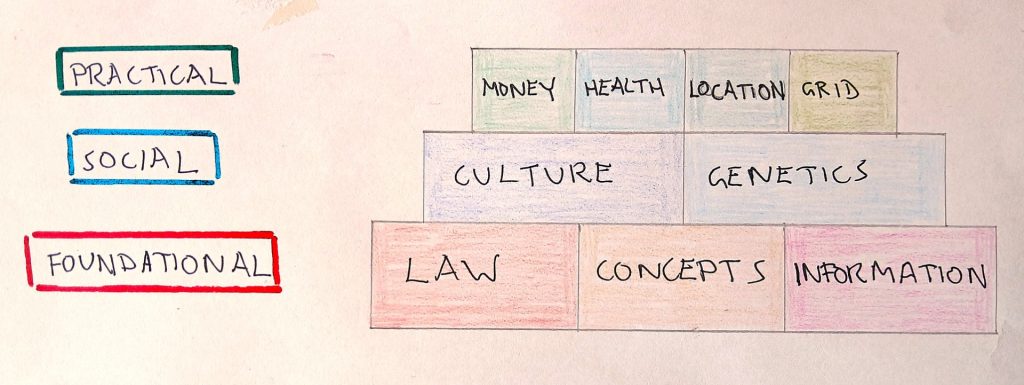
They’re arranged in three layers, where the ones above depend on (all) the ones beneath. They’re not in order of importance. Any freedom can become critical to you depending on your circumstances. I’m saying that the lower, more foundational freedoms must be solid in order to secure those that rest on them.
Lots of interesting conclusions come from this. One can avoid many tragic mistakes, or at least severe misapprehensions, through a thorough understanding of this simple picture. So let’s get acquainted with these domains and how they interact with each other.
Foundational Freedoms
These – Legal, Conceptual and Informational – are the bedrock of all other freedoms. Without them, you lack the legal protections, mental autonomy, or factual basis to exercise other freedoms meaningfully.

Legal
Legal freedom means that the State is not persecuting or prosecuting you – not placing excessive limits on your power to act. The primary legal freedoms are:
- Property rights
- Free speech
- Freedom from violence
Just as the primary colours combine to produce every visible hue in all works of art, these primary freedoms combine in a myriad of interesting ways; for example:
- Bodily autonomy (not your “freedom” to harm other people of whatever size, but to not have anyone else mess with your body without your informed consent) derives from strong property rights, since your body is your first and primary possession.
- Free speech implies freedom of association, since you’re not free to talk to whomever you want if you’re not allowed to consort with them.
- The legal right of citizens to be free from violence is, in theory, the raison d’etre of the entire police and armed forces. Freedom from taxation – or, if you’re squeamish, from “excessive” taxation – is the love child of property rights and freedom from violence, since taxes are taken not given, de facto at the point of a gun.
Since the State maintains a monopoly on violence, its rules form the hard-edged container of your life.

That’s why legal freedom (or lack of it) is absolutely foundational.
Conceptual
Conceptual freedom is when you can think what you want.
Yes, I know, you might feel like you can think whatever you want right now. But you can’t. And neither can I.
Power and openness
In order to think a thing, one needs several positive conditions. Here are two that depend on oneself:
- Raw processing power
- Intellectual openness
You need the IQ, g, or however else you like to represent mental processing ability, to be able to form and hold a particular concept in your mind. Difficult concepts require a certain capacity to be able to recognise them at all, just as heavy weights require a certain strength to even pick up at all, let alone lift with good form.
A terrifyingly large percentage of the world’s humans, for instance, finds it difficult or impossible to conceptualise hypotheticals, counterfactuals, or inception. Fewer, but still more than we would like, struggle with constructing a mental representation of another person accurate enough that they can predict or even acknowledge the reality of their feelings and reactions.
Some people even live without any real relationship with the future at all. Not in a cool, Zen-living-in-the-moment kind of way, but in a stunningly dysfunctional way that precludes any significant success with cause and effect.
Intellectual power is unfortunately 80% determined by birth (don’t complain to me I didn’t make the rules), and although it is easy to damage by pollutants or malnutrition, it is very difficult to increase. Good nutrition, good sleep, absence of chronic stress, and some supplements can help you think better, but only by a few percentage points. Importantly, you cannot educate your way to a different brain anatomy.
In that sense, this aspect of freedom, unlike the others, is pretty much impossible to secure for oneself or grant to others. I mention it for completeness, and because on a societal level and on a personal level we have to come to terms with it – I know I shall never be a genius, so I don’t waste my time or endanger others by trying to do rocket surgery.

Your natural range is not the only factor though. You also need intellectual openness in the sense that you actually want to be able to follow where your own thought leads you. Many (perhaps most) people do not possess this quality in any great degree.
You can tell that you’re talking to an NPC (Non-Player Character) when they only wish to hear their own past thoughts (which are actually the thoughts of others that they mistake as their own) repeated back to them in different words so that they may feel comfortable, and when any colouring outside the lines is met with confusion, anger, or fear. Do you want to truly understand, or do you just wish to feel “safe”? This is something one can work on.
In order to think well, your own qualities then need to meet an environment that’s free of obstacles.
Roadblocks
If you’ve already accepted something as true, you automatically tend to reject things that look like they will conflict with it. In this sense, existing concepts can block your way to better ones.
For example: If you believe that all Hobbitses are sneaky, wicked, tricksy, and false, you will resist any reasoning that might lead to the conclusion that the wickedness of Hobbits follows a normal distribution: a few are tricksy, most are nice, a few are nice and polite, albeit fat. But you will also irrationally resist many related ideas, such as for example that Dwarves (friends of Hobbits for the sake of argument or at least Hobbit-adjacent) are skilled and hard-working, or that the Shire, the Hobbit homeland, is beautiful and productive.
The absolute nastiness of Hobbits is a roadblock in your mind that makes it hard to assign any positive quality to anything related to them. A bad enough label is a roadblock to all further consideration; an emotion-hijacker, conversation-ender and thought-killer.
The test of a first-rate intelligence is the ability to hold two opposed ideas in the mind at the same time, and still retain the ability to function.
F. Scott Fitzgerald, “The Crack-Up”, 1936
This is why the Extreme Left, by the way, just like all autocratic systems, immediately and systematically deploys labels like weapons. Because they are.

Now, how do you come to believe that Hobbitses are tricksy and false in the first place?
Propaganda
This is how propaganda works:
- A trusted source (the government, the TV, someone in a lab coat, Saruman the White) makes a statement.
- The statement isn’t objectionable in itself (maybe it’s even attractive), but it rests on an unspoken assumption that you may or may not agree with, if you thought about it explicitly.
- You don’t think about it because you’re not really paying attention. You’re tired, self-medicated, frazzled by modern life, being besieged by Orcs.
- The assumption bypasses your conscious defences and settles into your subconscious like a poisonous, unnoticed snowflake.
- This happens ten thousand times until you are snowed in.
- You are now incapable of thinking anything that contradicts the assumptions implanted in you by whoever the hell rules the One Media.
It’s not always this subtle. Sometimes the lie is simply shouted at you with enough force that you go along with it.
But the subtle form is the more dangerous, because, if important enough, it is incorporated into the culture and passed down as unquestionable (sometimes, indeed, the truth is so obviously true and so unquestionable that heavy laws must also be passed imprisoning those who question it).
This is not a rant of merely academic or philosophical importance. This is our lived experience right now.
Let me give a topical example of an assumption that’s been planted in you by the Uniparty.
The Dependent Media always refer to people immigrating into and emigrating out of one’s own nation with the term “net migration” (and the number is always positive). This sounds agreeable, sensible, an educated way to see it, since “net” is a semi-technical term associated with government, economics, and other spheres in which Someone Else does the thinking for us. So it is accepted past your internal censor. But there are two major problems with it:
- It fixes the debate in terms of how much migration into a country is a “good” amount. We are invited to pick our own number – I say one million more cultural enrichers a year, you say two million more, and we argue within that frame. The idea that net migration should be a negative amount (which some people think it should be) is never, ever aired, and is thus subtly unthinkable.
- By framing the issue as quantitative, it eclipses the point that the qualitative aspect has equal impact. Who are the human beings behind the blank sums? If everyone leaving for brighter shores is wealthy, civilised, and skilled, and everyone entering is poor, hostile and uneducatable, that kind of ruins the game, doesn’t it? I’m not saying to what degree this is actually the case in any particular country. It’s just an example of how framing works. In Minecraft.
The real hidden assumption behind characterising immigration and emigration as mathematical is that everyone is the same. This assumption has been held in good faith by precisely no-one for all of history, does not stand up to the slightest examination, and would not be utterable these days without shame and derision, had it not been quietly slipped into the minds of Westerners (I can tell you that people outside European-heritage countries absolutely do not think this) over the past several decades.
Even if you think that net immigration should always be a positive number (for all countries? for ever?), that the quality of human capital immigrating and emigrating all countries is somehow always equal, and that everyone is the same – even if that’s your honest conclusion, you must still be able to see the dishonesty by which these ideas, true or not, are implanted and by which discussion of their merits is avoided. You must admit (or GTFO) that the best state of affairs is one in which everyone is free to come to their own conclusions about it, as you (probably mistakenly) believe you have – without undue influence.
Conceptual roadblocks prevent you thinking a thing. And we are, generally, not aware of the ones we have. Tools and techniques for identifying them would, in a sane society, be a very high priority to install in everyone. Maybe I’ll look at that one day.
Never use the terminology of your ideological enemy
Roadblocks can also come in the form of twisted, inaccurate, or ambiguous word meanings. These corral thinkers into going along with them. For example, the policies and attitudes that are destroying Western society today are most accurately called “subversive” because they are designed to subvert (undermine and destroy) the existing order. But the Bought-And-Paid-For media always use the term “progressive”. Progress is good, you see, so of course progressive ideas are good. What are you, stupid?
There are many other examples where the shiny new meaning is 180 degrees opposite to what the words actually mean:
- “Body-positive” actually means “promoting poor bodily health“.
- “Diversity” means “make everywhere the same, reducing actual diversity”.
- “Justice” used to mean “the administration of deserved consequences”. Its various new flavours mean “interfering with cause-and-effect to force a political outcome”.
- “Fascist” literally means someone who wants a large State and large corporations together to control everything. Nowadays if you try to reduce the scope of government the professionally ignorant call you a fascist.
- “Gender-affirming” means “sex-denying”.
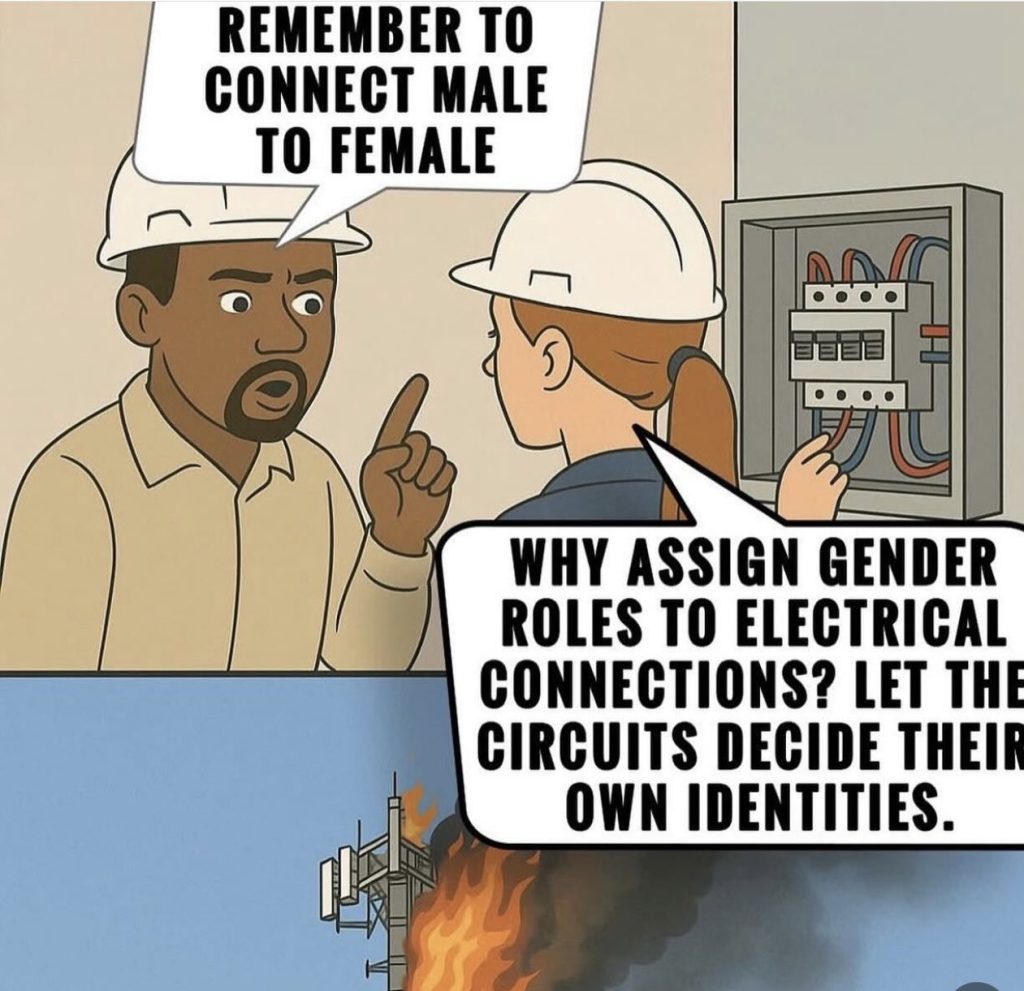
Don’t even get me started on “pro-choice” and “far-right”.
The Father of Western Thought himself saw this clearly.

Thus, you have conceptual freedom only when you have the processing power and the openness to think what you want, and your thinking is not distorted by propaganda or misleading language.
Informational
Informational Freedom is when you have quality and quantity access to news, science, facts, and history.
Quantity means that important or relevant things are not deleted, banned, shadowbanned, reach-limited, prevented from being published, removed from libraries, or burned in the streets.
Quality means that the information that exists is not biased or misleading.
Incidentally, Freedom of Speech doesn’t have its own section in my nice neat pyramid. It’s certainly a Legal matter. It’s also definitely related to Conceptual freedom, in that you need to be able to think a thing in order to say it. But it mostly belongs here, as the possibility to get – and give – information without hindrance.
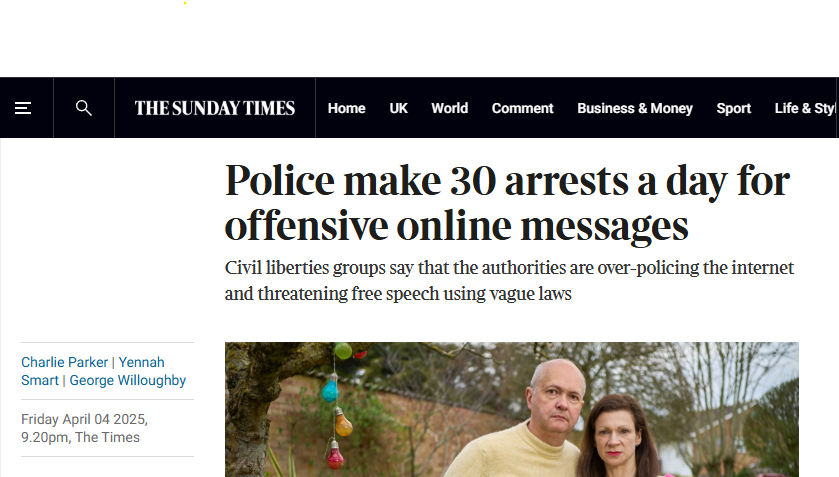
Why is Informational Freedom foundational? Because you need to know about the world in order to act in the world. You need an accurate map so that you can act to secure your other freedoms.
If you’re being lied to severely and consistently enough, it almost doesn’t matter how good you are at thinking, how much Conceptual Freedom you might have – you’re still not going to be able to act in accordance with how the world really is.
As a matter of fact, we are being misinformed or misdirected constantly about everything.
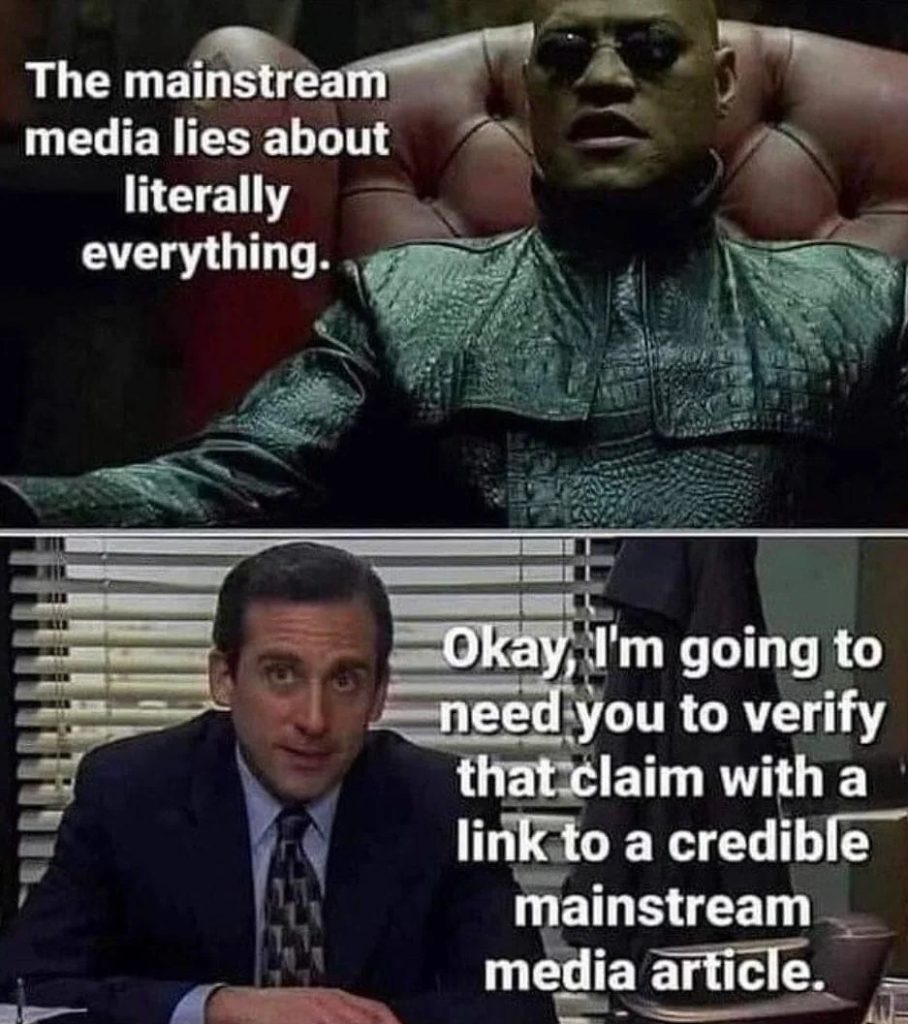
You think you have Informational Freedom, because we’re drowning in information, but the background is low-grade slop and the highlights are weapons-grade psyop.
Some people first realise this when the media, “experts”, or government comment incorrectly on something they actually know quite a lot about through independent research or direct experience. This is the most direct and irrefutable way to Notice, but only people who actually know things can do this.
Another way is by seeing brazen changes in the narrative, where the new thing contradicts the old one and crucially there is never an apology or honest acknowledgment of error. The world is ending because of Global Cooling. No wait it was always Global Warming. No actually everyone knows it’s any change in the ever-changing climate. And you have to fix it by freezing in the dark while China is building 80 coal-fired power stations a year.
You people have to have fewer children because the world is ending because of overpopulation – nope actually society is in danger because of underpopulation so we have to import people to keep the population growing.
“We have always been at war with Eurasia.” Or similarly, one can notice the failure of Their predictions (like the many passed deadlines for the world to have become uninhabitable). This is all quite simple, but only people who remember things can do it.
A more difficult method is to notice when the pretend problem doesn’t actually justify the proposed solution. As part of reducing our CO2 emissions we will decommission nuclear power plants, even though nuclear fission produces zero waste CO2, and replace them with short-lived, less efficient wind turbines whose lifecycle produces huge amounts of CO2 – and back up that unreliable power supply by burning gas that produces lots of CO2.

To reduce illegal immigration we will not enforce the border (boring!) but rather force legal citizens to use the hated Digital ID for some reason.
To increase tax revenue we must tax the wealthy until they leave, taking their money with them and decreasing the tax revenue. And on and on. To see this requires not only knowledge but, crucially, the rare technical ability to tell whether the given premises support a conclusion. This skill is the very essence of philosophy, properly taught, which probably explains why it is little taught, and when it is, not properly.
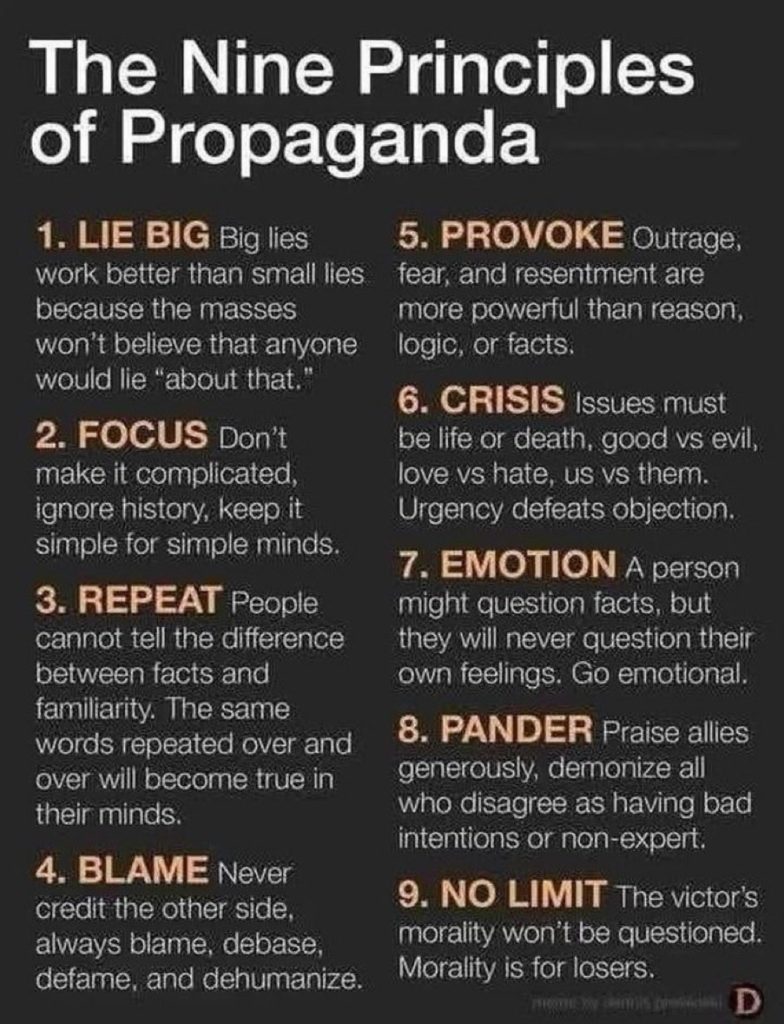
The last and most subtle way to tell that you are being lied to is to be familiar with the tools of propaganda.
Appeals to emotion, using partial truths, false flags, slander, lawfare, “hate buckets”, over-simplification, over-complication, sloganeering, and all the various other tricks and distortions of language.
For example, recall that in England and Wales deaths from Covid at its height without co-morbidities were about 4,500 per year, accidental falls kill ~10,000 a year, and the flu kills about 25,000 people per year. At that time, here are just a few of the tricks they played:
- They put up red (the colour is not accidental) signs on lampposts in my town informing us that the transmission rate of this largely harmless virus was INCREASING IN THIS AREA!!!
- They always reported the transmission rate (which was high) and never the death rate (which was low and falling).
- They would report the absolute numbers of deaths but never compared to other causes of death (Covid killed far, far fewer people than cancer, heart disease, etc.).
- They never broke the death data down by age and comorbidity. When people broke down the data themselves, they stopped giving out the raw data.
And on, and on. This is very difficult to spot, because smarter minds than you and I work very hard so that we cannot spot it.
If you are anywhere on the artistic spectrum, however, it becomes much easier. For normies, just ask “How would someone who cared about me explain this so I could make a calm, informed decision?” If what they’re giving you differs very much, then you know they do not want you calm or they do not care about you, or both.
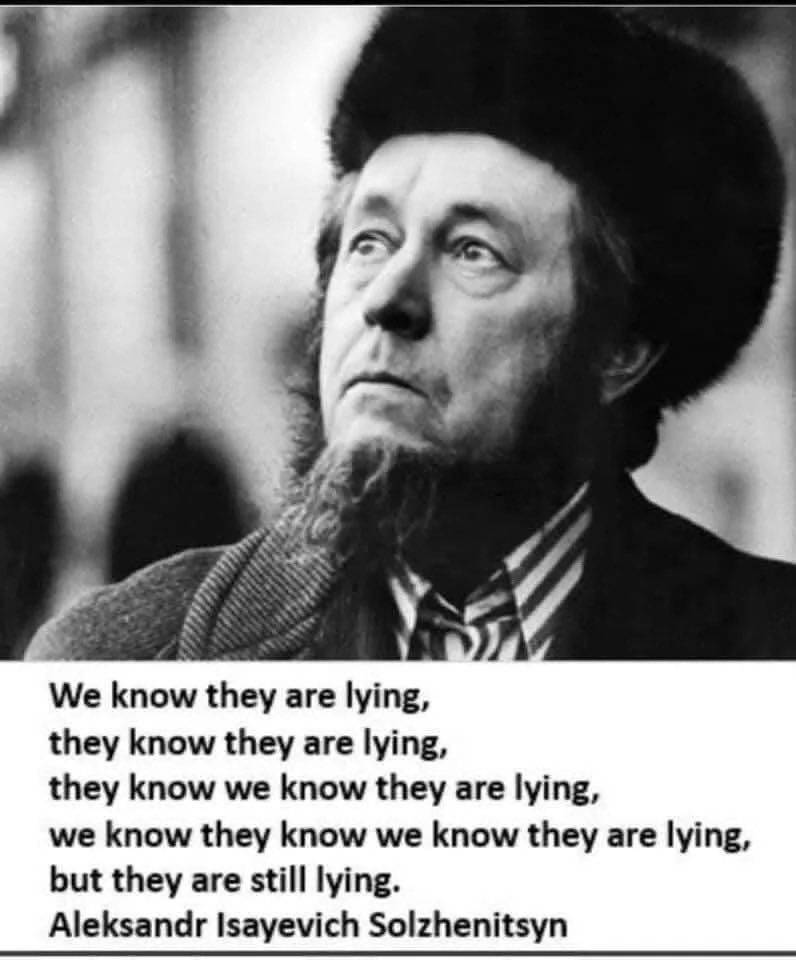
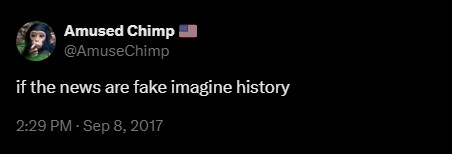
Of course, this lying has been going on for a long, long time.
To sum up: Foundational Freedoms – Legal, Conceptual, and Informational – define what you know, what you can think, and what you’re allowed to do. Everything else rests on them.
Social Freedoms
These – Cultural and Genetic freedom – shape the social environment in which other freedoms operate. They depend on Foundational freedoms and enable Practical freedoms by ensuring a supportive culture and community.

Cultural
On a personal level, Cultural Freedom simply means that your role in society does not limit your other types of freedom. For example, being a woman in Afghanistan limits your Conceptual Freedom because you aren’t allowed to go to school, and being a white male in most Western countries limits your Financial Freedom because DEI policies actively discriminate against you in the workplace (yes they do, hiring quotas are a zero-sum game).
On a general level, Cultural Freedom measures how free people are across all roles in a society. In other words, the overall level of freedom (or lack of it) due to cultural norms, as opposed to, for example, poverty, or legal restrictions. To the degree that it’s normal in your culture for everyone to do, think, and say the same limited set of things, and there’s some kind of informal social penalty for doing otherwise, you’re living in a culturally unfree society.

Whether this is a problem depends entirely on what those things are. If the culture prevents or discourages you from doing useful, enriching, constructive things, like educating yourself or providing for your family, then it’s a straight negative. The restriction on personal freedom carries over into restricted freedom for everybody by depriving them of the good consequences of the things you would have done.
If on the other hand social norms discourage you from doing stupid, destructive, subversive things, then this is on balance a Good Thing. Your lack of personal freedom in this sense results in an increase in everyone else’s freedom because they don’t have to deal with the fallout from your dumb ideas and actions.

The implications of this restrict-freedom-to-create-freedom have tempted philosophers from Mill to Hayek away from earning a respectable living for centuries. Here we’ll just note that Cultural Freedom is a real thing and when we say “more free” we mean “more free to do useful things”.
Although culture is both heavy and sticky, needing a lot of energy to change, it still depends on the freedoms below it, the Foundational Freedoms. It is strongly influenced by the law, by the thinking powers of its members, and by what they believe given the information they have available.
And how does it relate to its sister Social freedom, Genetic Freedom? Although culture and genetics are drawn in my pyramid as blocks alongside each other, they actually have a more Yin-Yang relationship.
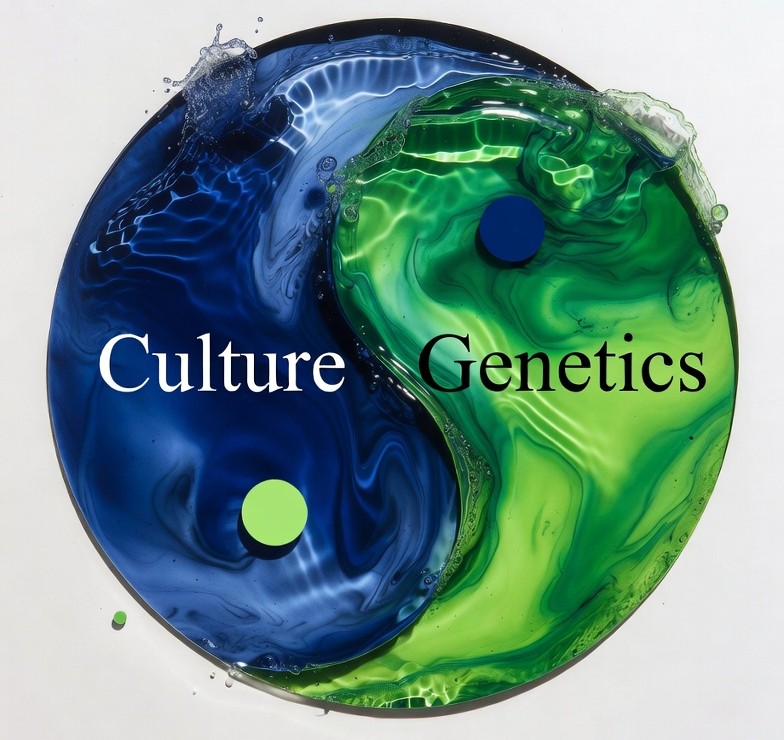
In this Yin-Yang picture, culture determines genetics.
For example, how a society administers healthcare influences who can conceive children and how likely they are to survive. How we think of economic roles, and how we organise business, taxation, etc., influences who can afford to attract a partner and raise children. And so on for every law, every social norm, and every interaction. So if someone objects that any attempt to influence genetics is “playing God” or worse, we can see that this is naive. Everything humans do influences genetics.
A Welfare State tends to reward failure, indolence, and carelessness, paying the least capable people to have more children than they can themselves support.
A corrupt State (e.g., Communism, Pirate Capitalism, or low-culture nepotism) rewards those who act badly – who inform on their neighbours, lead their company like a literal psychopath, or get hired based on who they know – in order to get ahead.
Both of these forms of culture are dysgenic, from the Greek dus meaning bad and genos meaning birth; crudely: something that degrades genes.

On the other hand, a functional society – think the West a couple of generations ago – rewards qualities such as intelligence, industriousness, and reliability. The more someone acts out these and other good qualities, the more money and status they acquire, and the earlier they can attract a high-quality husband or wife and start raising and supporting a (larger) family. This is eugenic, from the Greek eu meaning good: a process that improves genes.
When I say that everything that a culture does influences genetics, here’s a concrete example that we can all recognise. Modern car seat laws have saved lives. But they make it much harder for parents with a car to have more than two children (since you cannot fit three car seats in the back of most cars). This restriction has prevented far more births than it has prevented deaths. It forces those who can afford a car through their implementation of intelligence, industriousness and reliability, or who simply respect the rules, to have fewer children than those who do not. Such laws are therefore a dysgenic force.
Let’s pause a second. I know, you were told this kind of thinking is Not Allowed, and some of these perfectly ordinary and accurate terms are Bad Words for Bad People. If you’ve got this far, you are open to pursuing the truth over just following orders. So I can give you a simple trick to break the conditioning: “What’s the opposite?”
I say that we want good genes, and this is quite logical. And yet in some people it provokes a storm of guilt, fear, and whataboutery. So, what’s the opposite? Do we want bad genes? Do we want to encode for violence and stupidity and treachery in our neighbours, in our children? Do we want that now, and ever more of it in the future?
Obviously not. That would be the worst thing possible. That would be Hell on Earth. So when some person or inner voice (an echo of propaganda) tells you that preferring good genes is Mean, Not Fair, etc., remember what they’re actually advocating for, and ignore the hell out of them.
Lastly, looking upwards to the freedoms that it supports, culture clearly determines its members’ Financial Freedom by for example enabling different careers, Health Freedom by supporting different lifestyles, Location Freedom via social mobility, and Grid Freedom through education and norms of duty, as well as many other ways.
Genetic
Genetic freedom is the freedom to live, pay tax, be educated, run a business, find a mate, and relax among people with good genes.

What do I mean by good genes? Genes that encode for beneficial human properties. For example, intelligence is good, and as we saw, it’s 80% heritable. We can short-circuit the nature “vs” nurture objections by noticing the general principle – genetics both bounds and seeds our human potential.
Genetics bounds us by encoding for possibility. It’s impossible for a human to fly like a bird and there’s no amount of training that can change that (aeroplanes are cheating) because we don’t have the genes for wings.

Likewise, it’s not possible for someone with a low IQ to understand advanced things or behave by advanced ethical codes because it is just as hard a limit, albeit invisible.
Genetics also seeds us, because some genes encode for probability. Someone might have genes that carry a higher cancer risk, and yet not develop cancer in their lifetime, because that seed never grows. Perhaps it never gets watered by the rains of chronic stress, malnutrition, or chemical pollution. It was more probable that they got cancer, but that didn’t tell you whether they would or not. Likewise, there are specific genes that increase predisposition to violence.
For a specific outcome for an individual person this difference matters a lot. For our purposes, not so much. We are talking about Social Freedoms. We’re looking at patterns across huge numbers of individuals. As a society, we want both a high threshold for what good things are possible, and a high probability of good things happening. We want as good conditions and as good genes as we can get.

Some consequences of living in a poor genetic neighbourhood are immediate. If your children go to school, that education is disrupted and degraded. If you run a business, you pay an indirect tax in terms of robbery, higher insurance, day-to-day disruption, scams, and general bad-faith behaviour. If your neighbourhood has high genetic quality but your state or country does not, you pay for that indirectly in higher taxes. In a welfare State, taxes are essentially a wealth transfer from the high-functioning to the low-functioning, and if the low-functioning predominate, so much the worse for you.
Other consequences are more long-term. If the genetic quality of a country worsens, the physical infrastructure (conceived and maintained by conscientious, highly technical people) will degrade, albeit with a long lag.
Crucially, since we’re talking about genes, good mating opportunities become harder to come by. Constant noise and anti-social behaviour become a grinding social tax. Tolerance to noise is specifically a low-IQ trait (once you see it, you can’t unsee it). Customer service becomes a painful trial (think on your own experience and tell me I’m wrong). One’s stress hormones climb, worsening health. It becomes harder to relax, to create, to truly flourish.
In these ways and so many more, restrictions on Genetic Freedom affect your Financial, Health, and Grid freedoms. They also affect your Location freedom, in that changing locations helps you less the more the genetic quality of those locations is compromised.
So much for the downstream effects.
How do Legal, Conceptual, and Informational freedoms inform Genetic Freedom?
In some countries, zoning laws or immigration policies prevent communities from maintaining their cultural or cognitive norms, undermining their ability to choose the kind of society they want to live in. Limits to Conceptual freedom in the form of propaganda and denial of the possibility even to discuss such topics (see Roadblocks, above) rob people of the ability to think clearly about their Genetic Freedom. And finally, when the relevant statistics, data and studies are hidden or never even gathered, this crippling of Informational Freedom prevents people from forming reliable arguments one way or the other.
In these ways, the Law, Concepts, and Information – often influenced by State or vested interest group power – determine Genetic Freedom, which then determines everything else.
You might object that the idea of Genetic Freedom doesn’t make sense, since everybody can’t simultaneously have the right to live among intelligent, high-trust people at the same time as those intelligent, high-trust people also have the right to live among people like themselves. This is certainly a dilemma, although largely a false one introduced by the notion of a universal right, and in no way means that the concept of Genetic Freedom itself is incoherent.
Observe that in practice, everyone always tries to live among those with the best genes if they possibly can.
We saw above that culture influences genes. Of course, genetics also determines culture.
What differentiates a high culture from a low culture? It’s quite easy; just think of your ideal neighbours and in-laws. High cultures:
- Default to acting in good faith, even when no-one’s watching.
- Work hard.
- Plan long-term.
- Put truth above feelings.
- Aim for some kind of higher goal.
To explain the last point, the higher the culture, the more its people act for something bigger than themselves. This could be community, country, God, Science, or The Beautiful & True, however conceived.
Importantly, they do this even though it requires some personal sacrifice.
Whereas a low culture is composed of people who do the opposite:
- Default to acting selfishly unless there are immediate consequences.
- Do the minimum.
- Act on short-term impulses.
- Perceive the world primarily through feelings (especially egotistical ones such as grievances, offence, pride, jealousy, covetousness).
- Cooperate only as far as it benefits themselves.
I’m sure the intelligent reader doesn’t need me to explain how the first set of behaviours results in well-functioning institutions, intellectual and technological progress, safety, and prosperity, while the second inevitably, always and everywhere, results in the opposite. It’s kind of obvious. I will just offer one related observation of my own, which, if you will allow it to sit with you, might reveal some patterns in the world:
High-culture people create competence hierarchies. Low-culture people create dominance hierarchies.
But aren’t all these things learned? What do genes have to do with it? Unfortunately, rather a lot.
All of the good and bad behaviours above – as a simplification I want to say the ethical dimension of all behaviour – reduces to just three fundamental human characteristics, each of which has a genetic component:
- Time preference
- Impulse control
- Modelling
Time preference
Unless you’re a Bitcoin nerd you’ve probably never heard of this, but time preference makes sense of so much of the world. A high time preference means that you highly prefer the present. A low time preference means you value the future almost as highly as the present.
Let’s take a real example to see the difference. I used to live opposite a nice wine shop in the inner city. One day I saw a lady who worked there sprinting out and down the road. Turns out she was chasing a fellow from the housing estate, who had shambled in, grabbed a bottle of champagne, and run out. The story has a happy ending because she somehow didn’t get stabbed.
The thieving scrote had high time preference. To him, champagne = pleasure NOW. He discounted the future consequences, including potential imprisonment. This “future discounting” is another way of understanding time preference. Some amount of it is natural because after all we don’t know if we will live to see retirement, or even next week. But a psychologically healthy person values the future quite a lot and discounts it only lightly.
The shop hired a security guard after that. The manager showed low time preference. They took the pain of hiring and paying a guard upfront in order to prevent future trouble.

To have low time preference you must model the future, so it is related to Modelling. You must also control the impulse to act now. Thus all three of these areas – Time Preference, Modelling, and Impulse Control – are tightly related.
Does time preference have a genetic component? Bearing in mind that the current academic bias is firmly against finding real differences between different genetic groups of any kind, to the degree that they might take away your teaching credentials if you say something the Establishment doesn’t like (Nobel Prize winner or not), we should not expect too much. Still, the toes of truth poke out from under the blanket of suppression. Genes have been identified as playing a role here:
A person’s preference for smaller immediate rewards over larger delayed rewards is a heritable trait that is associated with psychiatric and physical outcomes… we identified 11 genome-wide significant loci.”
Thorpe, H.H.A., Cupertino, R.B., Pakala, S.R. et al. Genome-wide association study of delay discounting identifies 11 loci and reveals transdiagnostic associations across mental and physical health. Mol Psychiatry 31, 2081–2093 (2026).
Other studies have estimated the heritability of time preference as between 25-60%. It doesn’t make sense to me that studies control for things like intelligence, income, etc, since intelligence is correlated with time preference, and income is an outcome of time preference! If you did not manipulate the data in that way, I suspect the correlation between time preference and genes would be even higher.
Impulse control
In the well-known Stanford Marshmallow Experiment, a 5-year-old child is given a single treat – but told they can have two if they wait until the experimenter comes back. Those that wait longer go on to demonstrate more good qualities and outcomes when they grow up – better academic success, fewer behavioural problems, better ability to deal with stress. This is pretty intuitive. Succeeding in any of life’s challenges requires self-control.

Later experiments and analyses showed much weaker effects, because again they manipulated the data to “control” for related circumstances, such as mother’s education and household income.
Let me take a moment to explain how retarded this is. Imagine that some people have heads shaped like cones. For the sake of argument, 100% of coneheads have an IQ of ~70, do terribly on the Marshmallow Test (of course), and coneheadedness is 100% heritable. So naturally all conehead mothers have profoundly low educational achievement and their household income is very poor. Run the Marshmallow Test on a sample of people, some cone-headed and some not. Does a poor score accurately predict future difficulties and failures in life? Yes, perfectly.
Now “control” for mother’s education, or household income, or IQ, or crossword puzzles or knowledge of classical music or any of a thousand other related metrics. The effect will largely disappear. Does this mean the Marshmallow Test (or an equivalent, more rigorous test) is not useful, that it’s not measuring something real? No, it means that it’s very useful, because it points to something so fundamental that it affects multiple aspects of a person’s functioning at once.

The nerds are already up in arms at this point. Yes, I know that if you want to isolate the effect of impulse control specifically, perhaps because you think that teaching coneheads to wait longer for treats will make them successful in life (it won’t and also good luck), then you must adjust for confounding variables. But here we already acknowledged that time preference, impulse control, and modelling all come messily packaged together, and they influence everything. The Marshmallow Test is an easy way to remember it. So back in your box, nerds.
Now, is impulse control genetic in the real world? It certainly has large environmental factors (like how much you trust the dude in the white coat to give you more treats), but it is said to be about 30-50% heritable, which makes it very relevant for Genetic Freedom.
Animals generally cannot control themselves. The less impulse control we humans show, the more we resemble them. On the other hand, the more profoundly, widely, and extensively we act in spite of our impulses, the more distinctively human things we can achieve.

Works of art and literature, elevating personal relationships, sound engineering, impartial institutions, complex theories, all require dedication in the face of boredom and base desires.
Modelling
To do anything more complex than just reacting like the animals do, you need to create a mental model of what is happening. The two main models are Other People and Consequences.
There’s an interview on YouTube where TV personality Ross Kemp is interviewing some low-IQ gang rapists on the street:
“What about the consequences of what you’re doing in terms of how that affects the person that’s raped?”
– “She might scream, people might wake up.”
“I’m talking about the emotional effect it has on the girl.”
– “Yeah we know that we might wake up tomorrow with viruses ourselves.”
“What about regretting what you’ve done to the girl?”
– “I also do regret about it ‘cos if she fell pregnant who will be that baby’s father.”
“But what about her personal feelings?”
– (Laughter.)
“Aren’t you doing something that’s hurting another human being?”
– “When you do something like that you don’t think about the consequences, you just think about what is happening now.”
Let’s be clear about what’s wrong with these guys. It’s not that they know the pain they’re inflicting and revel in it, as movie psychopaths do. Nor is it that they simply “don’t care” about others’ feelings. They fail at the more basic step of understanding that others even have separate, authentic emotional experiences that exist independently of their own viewpoint (in psychology, this is called Theory of Mind). They are also pretty bad at modelling the future. Truly, they’re too unimaginative to achieve psychopathic levels of evil; theirs is a very flat and boring kind of wickedness. Note that they are not outliers in their community, nor are they unique across communities. Work with violent prisoners consistently reveals the same thing – they’re super-selfish because they just don’t get what it might be like to be someone else.
This is hard to understand and difficult to believe, and the reason why is actually incredibly interesting.
You, dear reader, by definition have an IQ of at least 120 (estimated by several state-of-the-art AI models as the threshold to understand this article). But you knew you were smart already. Here’s what you might not know:
Given a gap of 20-30 IQ points, it becomes difficult-to-impossible for people to understand each other.
This common claim is directionally consistent with psychological studies, although attempts to actually prove it are thin. Especially, I suspect that the more interesting direction, higher to lower, has not been studied at all. Let us examine it from first principles. It is easy enough to imagine that someone who understands concepts and uses words that we cannot grasp essentially inhabits a different world. And the research shows that given a large gap, higher-IQ people are indeed much lonelier and have less social interaction than when they are with their intellectual peers.
It’s the other direction that takes some imagination.
According to The Intelligence of Nations (Lynn & Becker 2019), there are 20 countries where the average adult IQ is 70 or less. For reference, the average European reaches the same mental level around age 10. This means there are entire countries where half of the adults have a mental age the same as or lower than than a Western ten-year-old.
Such unfathomably unintelligent people exist natively, in smaller ratios, in other countries, and they also travel. These days one can encounter them anywhere. How do they see the world, and how do they see you? It is almost impossible for you, with an IQ gap of fully 50 points, to imagine, even with your superior modelling skills, because from the outside they look and speak like adults. They have memorised several long words, even if they can’t read them. They may hold down a job, drive a car, or own a gun. As private or State functionaries they may even have official power over you in certain situations.
But from the inside, they cannot model the world, they don’t really believe that you have your own genuinely separate conscious experience, and they therefore cannot by definition have your best interests at heart.
To sum up, we must have ethical qualities (coupled with intelligence, discussed earlier) to have a stable, peaceful, prosperous, civilised society. The rainbow of ethical qualities fractures from the primary colours of low time preference, impulse control, and modelling. These ethical qualities include emotional maturity, empathy, self-restraint and sacrifice – what we traditionally understood by the term moral fibre.
And to the extent that brain structure or other heritable characteristics determine these qualities – which as we have seen is something between somewhat and really quite a lot – the whole of modern life can be reduced to a simple equation: civilisation = genes.
Culture and genetics are thus two sides of the same inseparable coin. Never forget.
Practical Freedoms
These are the tangible freedoms that let you live your chosen life: Financial, Health, Location, and Grid. They are largely results of Fundamental and Social Freedoms.

Let’s look at them in reverse order.
Grid
Basic Grid, or Infrastructure Freedom, means enjoying well-functioning systems of power, internet, water, transport, etc. This is possible only if highly-trained, diligent, honest, non-impulsive people invent, design, create, implement, and maintain it for you. If workers mend the roads badly so that they can be employed again next year to fix them, or citizens steal copper from the transformers, or officials just embezzle the funds, then it’s not possible. Therefore, it entirely rests on Cultural and Genetic Freedom.

Advanced Grid freedom means that you are not dependent on one set of infrastructure. For example, having an off-grid retreat, or a self-sufficient motorhome, or a property you control in another country, means that you can still function if a centralised grid fails.
Special shout-out to Legal Freedom here as supporting or destroying Grid Freedom. Moving your family to a literal cabin in the woods means nothing if a Federal agent tries to fill their quota by enforcing the letter of some overbearing law.

Location
Geographic, or Location Freedom, means that you can live in the location you choose – and that you benefit from increased freedom from that location:
Better locations offer some combination of superior infrastructure resilience, healthier environments, more job opportunities (or lower taxes, or a good exchange of taxes for quality of life), better genetic quality, more positive culture, greater legal freedom, and less censorship – covering all our other Freedoms.
Within the same legal jurisdiction, it’s worth noting that cities give you maximum options and countryside gives you fewer risks.

How do the other Freedoms help or hinder?
Location freedom is enabled or denied, like all the other Freedoms, by Legal Freedom. You need not just the physical ability to up and move somewhere, but the legal basis for functioning in society in the new place, and for passing any borders on the way.
It also requires Conceptual and Informational Freedom so that you can make an informed, free decision. As a result of the information in this article, for example, you might think differently about the best places to live.
Depending on the level of Cultural Freedom, your fellow citizens will be more or less helpful to you in moving to a different jurisdiction.
As for the last of the “lower” freedoms, Genetic Freedom, it tends not to stop you moving places but rather motivate you to choose wisely.
Of the peer Freedoms, Financial Freedom stands out as the main enabler for Location Freedom; it’s directly constrained by wage dependence (especially being tied to an office).
Health
Health freedom means that you are mobile, active, decisive, and not particularly more likely than the rest of us to die any time soon.
If you have good health, you are naturally able to achieve all of your goals more effectively, including maximising any and all of the other Freedoms.
For their part, the other Freedoms very strongly enable or limit your health. Poverty is synonymous with poor health. Being in a low-quality location is certainly not good for you. Dealing with unreliable infrastructure, such as blackouts, inability to travel on time, etc., is at best very stressful, at worst life-threatening.
Social and Genetic freedoms matter a lot for health. Restrictive, frustrating social conditions create stress that will kill you slowly. Getting stabbed is also generally quite bad for you.
Clearly, a lack of reliable health information (don’t get me started on the medical-industrial complex and its censorship) stops you being able to take effective care of your body and mind.
And lastly, if the State is persecuting or prosecuting you, this is also not great for your health.
Financial
Financial freedom is one we all recognise and aspire to. Money is crystallised human effort in transferable form, and you can exchange it, to some extent, for Time, Health, and Location Freedoms for yourself and those closest to you.
True Financial Freedom means not just that you have enough money to do things, but that your source of money itself experiences freedom. If your only income is a wage from an office job, then no matter how high the number, you are not very free, because you can lose it at the whim of the company. Wage cuckery also limits your Location Freedom, unless the job is truly remote. Income from location-independent businesses or investments is thus a higher form of Financial Freedom.
So much for the other Practical Freedoms. How does Financial Freedom interact with Social and Fundamental Freedoms? The power goes almost entirely one way – they enable or limit it. If you live in a low culture, it’s hard to make money in the first place, and your riches still can’t buy you a relaxing walk around town.
Likewise, if Genetic Freedom is poor, you will burn though savings just insulating yourself from negativity.

Informational Freedom gives you the data about the economy, job market, international arbitrage, risks, etc., that you need in order to make and maintain money. Conceptual Freedom allows you to process it accurately.
The clearest influence, however, comes from Legal Freedom. The government can simply take your stuff. They can do this all at once by seizing your land and property, Zimbabwe-style, or over generations with inheritance taxes, or they can do it slowly, grinding you between the “millstones of taxation and inflation”.

So, even if you are well off, deterioration in any of the lower Freedoms can still ruin it for you. It’s not about being a big fish in a small pool, or a small fish in a big pool. It’s about not swimming in poisoned waters.
This is why the proper freedom-maximising use of money is to secure your Legal, Social, and Genetic Freedoms. Accounting and legal structures aside, the biggest way to do this is to move somewhere more free.
Conclusion
Every kind of Freedom has specific relations with every other. You probably want to maintain a minimum level of each kind, but pay special attention in the long term to Foundational Freedoms – Legal, Informational, and Conceptual. This means: try to live somewhere free, without too much censorship, and from your own side, be open-minded.
This framework also tells us what the money we spend our lives trying to accumulate is really for. The point of money is to enjoy your Health, Location, and Grid freedoms (and use the resulting freedom of action to improve things for your fellow man). You can only reliably and efficiently do this if you have a high level of Legal, Conceptual, Informational, Cultural, and Genetic freedom.
Thus, whether you can or can’t move, wherever you end up staying, this is the inescapable conclusion:
Funding activism that improves the legal, informational, cultural, and genetic situation where you are gives the highest return on investment.
Thanks for reading. To your freedom!
🌍 Share this:
Want more to read? Here are my latest articles: